Store Credit vs Refunds on Shopify: What Every Merchant Needs to Know (2026)
 Written byAyushi Tyagi
 Reviewed byAnuj Goel
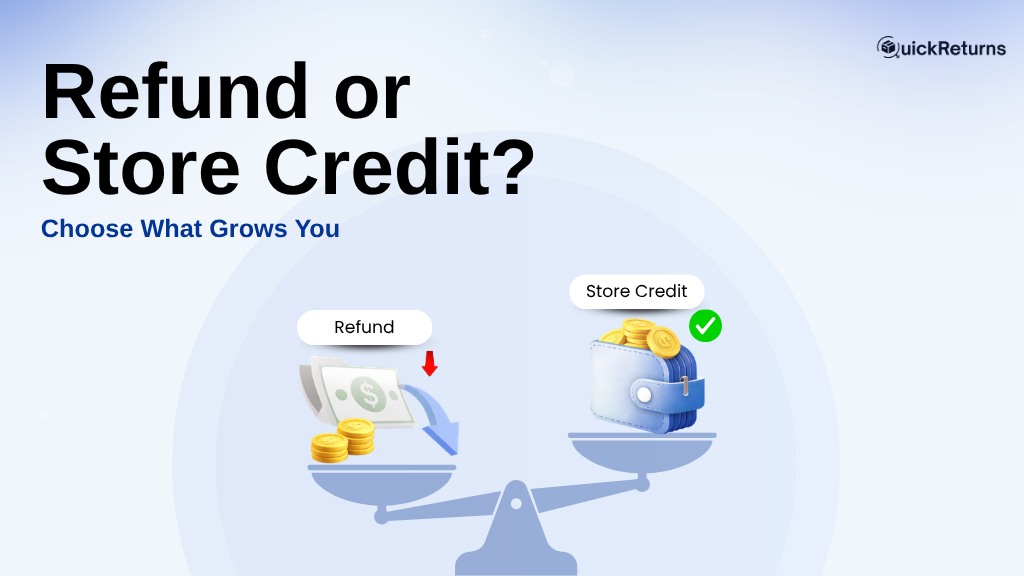
Every return request ends in one of two ways. With a refund, the money leaves your business. With store credit, the revenue stays and the customer has a reason to shop again. This guide covers store credit vs refund for Shopify merchants: what each one means, how Shopify store credit works, and when to offer which.
Shopify now has a native store credit option. However, it is still a manual tool, so we also explain where a returns app helps.
What does “refund mode: store credit” mean? It means the refund was not sent back to the card, UPI or bank account used for the order. Instead, the amount was added as a credit balance to the customer’s account with that store. The customer can spend that balance on a later order from the same store.
Store credit vs refund: what is the difference?
A refund returns money to the customer’s original payment method (credit card, UPI, wallet, etc.). The transaction reverses. As a result, you lose the sale.
Store credit keeps that money inside your store ecosystem. You issue the customer a credit balance they can use on their next purchase. The revenue stays with you. So the customer has a reason to come back.
In short, a store credit refund keeps the sale inside your store, while a refund to the payment method ends it. The table below compares the two.
| Question | Store credit | Refund |
|---|---|---|
| What the customer gets | A credit balance on their customer account | Money back to the original payment method |
| Where the money goes | It stays in your store until the customer spends it | It leaves your business |
| How the customer uses it | At checkout, on any later order from your store | Anywhere, with no tie to your store |
| Works best for | Size or fit returns, repeat-purchase products, loyal customers | Damaged or defective items, unhappy first-time buyers, cases where the law requires a refund |
| Main risk | The customer feels forced if a refund is not offered as well | The customer has no reason to come back |
Why Refunds Are Hurting Your Bottom Line More Than You Think
Returns are a large cost line. In the United States, retailers estimated that 16.9% of their annual sales in 2024 would be returned, according to the National Retail Federation and Happy Returns.
Now think about what happens every time you issue a refund:
- The sale revenue is gone
- You absorb the return shipping cost (often both ways)
- Payment processing fees may not come back to you
- The returned item may not be resellable at full price
So each refund costs more than the sale itself. If you operate on thin margins, as most DTC brands do, it adds up fast.
Store credit changes that equation entirely.
Shopify Native Store Credit: What It Is and How It Works
Shopify added native store credit in its Summer ’24 Edition. It lets merchants issue credit from the Shopify admin to a customer’s account. The full rules are in Shopify’s store credit guide.
Here’s how it works:
- You issue store credit from the customer profile page inside Shopify admin
- The credit is account-bound: it shows up automatically at checkout for that customer
- Customers can use it as a payment method just like a credit card or UPI
- You get a full transaction history for each credit issued
Important requirement: customers can spend store credit only when they are signed in through customer accounts or use Shop Pay. Store credit is not available for legacy customer accounts. You can turn store credit on or off in the Customer accounts settings.
How to issue store credit on Shopify (step by step)
Here is how to give store credit on Shopify from the admin, following Shopify Help. First, check that the staff member has the Store credit and Edit store credit permissions.
- Go to Customers and open the customer profile.
- In the Store credit section, click Edit, then select Credit.
- Enter the amount. If your store sells in several currencies, pick the currency as well.
- Select No expiry date or set an expiry date.
- Click Review changes. Optionally, select Notify customer to send an email.
- Click Credit to issue it.
After that, the new balance shows on the customer profile and in the customer’s account. In addition, Shopify limits store credit to less than $15,000 USD on a single customer account.
Refund to store credit on Shopify: how a store credit refund works
A store credit refund on Shopify sends the refund amount to the customer’s store credit balance instead of the original payment method. You select store credit as the refund method on the order’s refund screen. You can also split one refund between the payment method and store credit.
Shopify added this option to the refund screen in May 2025 and to the return and exchange flow in July 2025. A few rules apply, according to Shopify’s refunding orders guide:
- Only the store owner, or staff with the Refund to store credit permission, can do it.
- You can set an expiry date on the credit. However, check local law first, because the rules on expiry differ by country.
- If the customer later wants the money back, you can still refund to the original payment method. That does not remove the credit already issued, so reduce the balance yourself.
As a result, a Shopify refund to store credit is still a staff action on each order.
Limitations of Shopify’s Native Store Credit
Shopify’s built-in feature is a solid starting point, but it comes with real limitations that matter for merchants dealing with high return volumes:
- Full balance only: Customers can’t choose to use a partial amount. The entire credit balance gets applied at checkout, which can feel limiting for customers with large credit balances.
- A manual step on every return: a staff member has to select store credit on the refund screen, or add it on the customer profile, for each order.
- No bonus credit incentives: You can’t offer “Get ₹500 credit instead of ₹400 refund” nudges natively. There’s no built-in mechanism to incentivise credit over refunds.
- Currency-matched only: In multi-currency stores, store credit only shows at checkout if it matches the active checkout currency.
- One customer at a time: the admin steps issue credit from a single customer profile. To credit 200 customers after a bad shipment batch, you need the API or an app.
For merchants processing dozens or hundreds of returns per month, these gaps matter a lot. That’s where a dedicated branded return portal and returns management app fills in the blanks.
The Real Business Case for Store Credit on Shopify
When a customer chooses store credit over a refund, whether through Shopify native or an automated returns flow, here’s what actually happens:
1. You keep the revenue in-house. That ₹2,000 (or $50) doesn’t leave your business. It waits in your customer’s account, ready to be spent again.
2. You drive repeat purchases. A customer with outstanding credit has a reason to come back.
3. You increase average order value. When customers redeem store credit, the order can be larger than the credit. The difference is new revenue.
4. You reduce refund processing overhead. Fewer refunds mean less reconciliation, fewer payment disputes, and less load on your support team.
For a Shopify brand doing 500 returns a month, converting even 30% of those to store credit instead of refunds can mean lakhs of rupees (or thousands of dollars) retained every single month.
When Store Credit Works Best (And When It Doesn’t)
Store credit isn’t a one-size-fits-all answer. Here’s a practical guide.
Use Store Credit When:
- The return is size or fit related. The customer likes your brand. They just need a different variant. Credit keeps them in your store for the second purchase.
- You sell repeat-purchase products. Apparel, accessories, home goods, beauty: categories where customers buy again and again. Credit accelerates that cycle.
- You want to reward loyalty. Giving loyal customers store credit (sometimes with a small bonus) turns a frustrating return into a positive brand moment.
- You’re processing high return volumes. Automating store credit issuance at scale is far more efficient than processing individual refunds manually.
Use a Refund When:
- The product was defective or damaged. Customers who received a bad product deserve their money back. Pushing store credit here damages trust.
- It’s a first-time customer with a bad experience. A frustrated first-timer won’t come back anyway. A clean refund ends the relationship without further damage.
- Regulations require it. In some markets and product categories, full refunds are legally required. Always know your obligations.
The key is having the flexibility to offer both, and the intelligence in your returns flow to present the right option at the right moment.
Store credit first or refund first, by business type
Your returns policy is a decision you make once, based on what you sell and what your customers expect. After that, you automate it.
| Store credit first | Refund first |
|---|---|
| Fashion and apparel. Customers come back for the next season, so credit keeps them with you. | Electronics and high-value goods. Customers buy once and spend a lot, so a clean refund protects trust. |
| Beauty and wellness. A loyalty-driven category where credit builds the repeat habit. | Furniture and home décor. Repeat purchases are rare, so credit has little value to the customer. |
| High SKU count, high return volume. Size and fit returns are expected, and credit is efficient to run. | Regulated categories. Some markets require refunds by law, so check your obligations first. |
| Mid-premium D2C brands. Customers chose you for the brand, and credit signals confidence in the product. | International-first brands. Cross-border customers are cautious, and refund-first builds trust. |
For most D2C brands: default to store credit, but keep a refund available for defective products and bad experiences. Set the rule once and let your returns platform apply it.
Store credit vs exchange credit on Shopify
Merchants often search for “Shopify exchange credit”. Shopify treats the two as separate things, so it helps to name them.
Store credit is a balance on the customer’s account. The customer can spend it on any later order.
An exchange, in Shopify’s returns and exchanges overview, sends the customer an alternative item as part of the return, such as a different size or colour. In that case, the value of the returned item goes toward the replacement. That is what people usually mean by exchange credit (see how exchanges retain revenue in practice).
The two also work together. For example, Shopify lets you refund to store credit while you process a return or an exchange. Therefore, your return flow can offer three outcomes: an exchange, store credit or a refund.
This is where the design of your return portal matters, because it decides which option the customer sees first.
Which returns tools issue store credit instead of refunds?
Two kinds of tools can issue store credit instead of a refund on a Shopify store.
Shopify’s native store credit. It lives in the Shopify admin. A staff member selects store credit as the refund method on an order, or adds credit on the customer profile. We describe both routes above.
A returns app with a wallet. In the QuickReturns return portal, for example, the shopper picks the refund method while they request the return. The options are the QuickReturns wallet (store credit), the original payment method, a bank transfer or UPI. As a result, the shopper makes the choice up front, and you approve the request manually or with an automatic rule.

For the wider process around refunds and credit, see our guide to ecommerce returns management.
How QuickReturns Automates Store Credit Within Your Returns Flow
Shopify’s native store credit is a great foundation, but it’s a manual tool. You issue it, you decide when, and you do it one order at a time.
For merchants processing returns at scale, that’s not sustainable.
QuickReturns plugs directly into Shopify’s store credit infrastructure and automates the entire flow:
- Automatically issue store credit when a return is approved, with no manual steps
- Offer bonus credit nudges (e.g. “Get ₹500 store credit, ₹50 more than your refund”) inside the return portal to shift customer choices
- Let customers choose between refund, store credit, or exchange within one portal
- Handle multiple line-item returns in a single request with one AWB and one payout, something even most enterprise tools don’t do cleanly
- Track retention metrics: see exactly how much revenue your returns flow is retaining vs losing
The ConvertX feature is built specifically for this: converting return requests into retained revenue by making store credit and exchange the path of least resistance in your return flow.
The Numbers: How Much Revenue Can You Actually Retain?
Let’s make this concrete.
Imagine your store processes 300 returns per month at an average order value of ₹1,800.
That’s ₹5,40,000 in return value every month going through your returns process.
| Scenario | Revenue Retained |
|---|---|
| 100% refunds (default) | ₹0 |
| 20% converted to store credit / exchange | ₹1,08,000 / month |
| 35% converted to store credit / exchange | ₹1,89,000 / month |
At 35% retention, that’s over ₹22 lakhs a year that would have walked out the door, now staying in your business.
The math makes the case. The only question is whether you have the right flow in place to make it happen.
Store credit, exchange or refund: a scenario guide
| Return situation | Best option | Why it works | Revenue outcome |
|---|---|---|---|
| Wrong size or fit (apparel, footwear) | Store credit | The customer still wants your product. Credit keeps them in the store for the right variant. | Retained |
| Wants a different colour or variant | Exchange | A direct swap, with no credit and no refund. | Retained |
| Changed mind, loyal customer (3 or more orders) | Store credit | A small bonus credit rewards loyalty. | Retained |
| Changed mind, first-time buyer | Offer both | Show store credit first and keep the refund available. | Depends on the customer’s choice |
| Product arrived damaged | Refund | It was the merchant’s error, so credit feels like cost-shifting. | Lost, trust kept |
| Product not as described | Refund | Fix the listing and refund the order. | Lost, dispute avoided |
What a Smart Return Policy Looks Like in 2026
The best Shopify merchants today aren’t trying to avoid returns. They’re building return policies that work for the business, not just the customer.
A high-performing return policy in 2026 typically includes:
- Clear eligibility windows: 15, 30, or 60 days depending on your category
- Condition requirements: unworn, original packaging, tags attached
- Tiered return outcomes: store credit (with optional bonus), exchange, or refund, presented in that order
- Policy exceptions: sale items, customised products, hygiene items
- A self-serve return portal, so customers don’t need to contact support to initiate a return
This structure builds customer trust before purchase (reducing hesitation) while steering return outcomes toward revenue retention automatically. Our Shopify return policy template follows this structure, so you can adapt it directly.
See how QuickReturns’ pricing plans are structured for brands at every volume.
Frequently Asked Questions
Does Shopify have a native store credit feature?
Yes. Shopify added native store credit in 2024. Merchants issue it from the customer profile in the Shopify admin or as the refund method on an order, and customers apply it at checkout. However, it is not available for legacy customer accounts, and a staff member issues each credit.
How do I give a customer store credit on Shopify?
Open the customer in your Shopify admin, go to the Store credit section, click Edit, select Credit, enter the amount and confirm. Alternatively, select store credit as the refund method when you refund an order. In both cases, the customer applies the balance at checkout when signed in to their account.
What does a store credit refund mean?
A store credit refund means the value of the returned order is added to the customer’s balance with the store. It is not sent back to the card or bank account. Instead, the customer uses the balance on a later purchase from the same store.
Will customers react negatively to being offered store credit instead of a refund?
Not if it’s done right. Customers react negatively when they feel forced into store credit. If it’s presented as an option, especially with a small bonus, customers are far less likely to feel forced. Transparency and choice are key. A well-designed return portal makes store credit feel like the better deal, not a workaround.
What’s the difference between store credit and a gift card on Shopify?
A gift card is a physical or digital code with a fixed value, often purchased or gifted to someone. Shopify’s native store credit is tied directly to a specific customer account and issued as a return or goodwill outcome. Store credit is account-bound and automatic at checkout: the customer doesn’t need to enter a code.
How do I automatically issue store credit when a return is approved?
Shopify’s native feature needs a staff member to issue each credit. A returns app can move that choice into the return request. For example, in the QuickReturns portal the shopper selects the QuickReturns wallet (store credit) as the refund method, and you can approve requests automatically with rules.
Is store credit a good fit for all Shopify stores?
It works best for repeat-purchase categories: fashion, accessories, home décor, beauty, sports. For one-time-purchase or high-ticket categories, customers are more likely to want their cash back, and in those cases, a clean refund often serves the relationship better.
Refunds are a cost. Store credit is a strategy.
Shopify’s native store credit feature is a great step, and if you’re not using it yet, start using it today. But for brands processing returns at scale, the real lever is automation: automatically offering store credit, nudging customers toward it with smart incentives, and handling exchanges in the same flow.
That’s what separates a returns process that leaks revenue from one that retains it.
The Shopify merchants doing well in 2026 decide the return outcome in advance and let the flow apply it.
→ See how QuickReturns helps 1,000+ Shopify brands automate returns and retain revenue
→ Book a free 20-minute demo. We’ll show you exactly how to set this up for your store.
Already using a different returns app? QuickReturns offers one-click migration with zero downtime. See how we compare →
Or install directly: QuickReturns on the Shopify App Store →
