QuickReturns vs. Return Prime: Which Shopify Returns App Is Right for Your Store in 2026?
 Written byAyushi Tyagi
 Reviewed byAnuj Goel
Quick Returns vs Return Prime: this post compares the two Shopify returns apps on their published plans and prices. In short, QuickReturns has the larger free plan, with 10 return requests a month against 5. It also has the lower starting price, at $19 a month for 60 requests against $19.99. In addition, every QuickReturns paid plan includes every feature.
Today, 1,000+ brands use QuickReturns. For a wider view, see our list of the top Shopify returns apps in India.
Everything about Return Prime here comes from its Shopify App Store listing, its own website and GoKwik’s product page. Plans change, so check those pages before you decide.
Quick Returns vs Return Prime: the quick answer
For most Shopify D2C brands, QuickReturns is the better pick. Four published facts back that up:
- Free plan: QuickReturns covers 10 return requests a month, while Return Prime covers 5.
- Starting price: 60 requests a month cost $19 on QuickReturns and $19.99 on Return Prime. After that, each extra request costs $0.40 instead of $0.49.
- Features: every QuickReturns paid plan includes every feature. So the $19 plan has bonus store credit, API access and webhooks, whereas Return Prime lists those on its Scale plan.
- Support: every QuickReturns plan, including Free, comes with a dedicated account manager, a 1:1 onboarding call and live chat support.
Return Prime may suit you better if you already use GoKwik products (GoKwik lists it among its products), if you want the AI-set exchange discounts and return fees on its Thrive AI plan, or if you want upsells during a return on a free plan.
QuickReturns: what you get on each plan
The QuickReturns Free plan costs $0 and covers 10 requests a month. It comes with a branded returns portal on your store’s own subpath. You can also add your logo, brand colour, custom CSS and translations.
The Free plan also includes:
- Variant and price-difference exchanges
- Refunds to store credit and gift cards
- Several items in one request
- Logistics integrations for reverse pickups, plus WMS and OMS integrations
- Live chat support, a 1:1 onboarding call and a dedicated account manager
However, requests stop at 10 until the next month or until you upgrade.
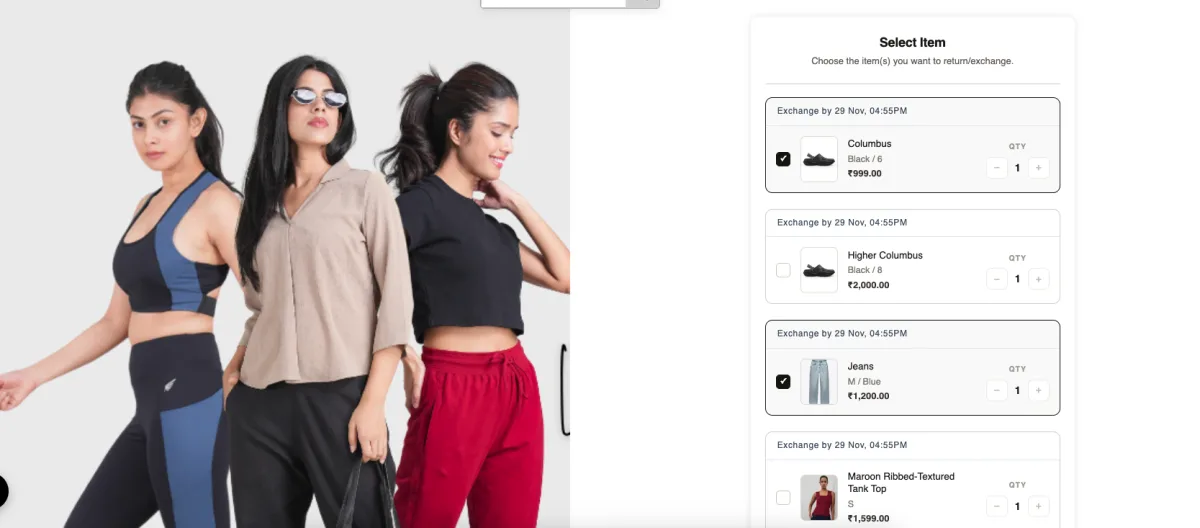
QuickReturns paid plans differ only by volume:
- Growth: $19 a month for 60 requests, then $0.40 per extra request
- Boost: $49 a month for 300 requests, then $0.30 each
- Scale: $99 a month for 500 requests, then $0.20 each
- Custom: above 500 requests, with a rate set for your brand
Every QuickReturns paid plan includes every feature. One limit to know: the Free plan leaves out exchanges for a different product, ConvertX offers and upsells, bonus store credit and automations (automatic approvals, refunds and exchanges). It also leaves out team members, API access and webhooks. Those start with Growth at $19 a month.
Shoppers can take a refund to the QuickReturns wallet (store credit), the original payment method or a bank transfer. QuickReturns sends email notifications as standard. SMS (a paid-plan feature) and WhatsApp work once you connect a provider.
Return Prime: plans and features
Return Prime calls itself “a returns & exchanges platform for growing D2C brands”. Its Shopify App Store listing shows a developer based in India, and GoKwik lists the app among its products. The company also says that 10,000+ global brands trust it, and that it connects to 100+ WMS and logistics tools.
Its App Store listing shows four plans:
- Start: free to install, 5 return requests
- Grow: from $19.99 a month, 60 requests
- Thrive AI: $79.99 a month, 180 requests
- Scale: $149.99 a month, 450+ requests
Extra requests cost $0.49 each, or $0.79 on Thrive AI. The three paid plans also come with a 15-day free trial.
Features vary by plan. First, the free plan has the branded portal, variant exchanges and upsells during a return. Grow then adds auto-approval, return automation, exchange for a different product and refunds by bank transfer. Thrive AI builds on Grow with AI-set exchange discounts and return fees. Scale also builds on Grow, and adds WMS integrations, webhook and API access, bonus credit and UPI refunds.
Quick Returns vs Return Prime: side-by-side comparison
The tables below use each app’s published plans and prices.
Plans and prices
| QuickReturns | Return Prime | |
|---|---|---|
| Free plan | 10 requests a month | 5 requests a month |
| Starting paid plan | Growth: $19 a month, 60 requests | Grow: from $19.99 a month, 60 requests |
| Extra request on the starting plan | $0.40 | $0.49 |
| Middle plan | Boost: $49 a month, 300 requests, then $0.30 each | Thrive AI: $79.99 a month, 180 requests, then $0.79 each |
| Top listed plan | Scale: $99 a month, 500 requests, then $0.20 each | Scale: $149.99 a month, 450+ requests, then $0.49 each |
The same volume, side by side
Return Prime’s pricing page has a volume selector with three settings. So this table puts QuickReturns next to its Grow and Thrive AI plans at the same monthly volume.
| Requests a month | QuickReturns | Return Prime Grow | Return Prime Thrive AI |
|---|---|---|---|
| 60 | Growth: $19 | $19.99 | $29.99 |
| 180 | Boost: $49 (300 included) | $49.99 | $79.99 |
| 450 | Scale: $99 (500 included) | $99.99 | $159.99 |
Which features are on which plan
| QuickReturns | Return Prime | |
|---|---|---|
| Features on paid plans | Every feature on every paid plan | Features vary by plan |
| Branded returns portal | Every plan, including Free | Every plan, including Free |
| Variant exchanges | Every plan, including Free | Every plan, including Free |
| Exchange for a different product | Every paid plan | Grow and above |
| Automatic approvals | Every paid plan | Grow and above |
| Offers and upsells during a return | Every paid plan (ConvertX) | Every plan, including Free |
| Bonus store credit | Every paid plan | Scale plan |
| API and webhooks | Every paid plan | Scale plan |
| WMS and OMS integrations | Every plan, including Free | Scale plan |
| Logistics integrations | Every plan, including Free | Up to 2 below Scale, unlimited on Scale |
| Refund by UPI | Every plan, including Free | Scale plan |
| Live chat | Every plan, including Free | Every plan |
| Account manager | Every plan, including Free | Thrive AI and Scale plans |
| Onboarding | 1:1 onboarding call on every plan, including Free | Dedicated onboarding on Grow and above |
Both apps change their plans from time to time, so confirm on each pricing page before you decide. See QuickReturns pricing for our current plans.
Sources: Return Prime on the Shopify App Store · Return Prime pricing page · Return Prime on GoKwik’s site · Return Prime’s homepage
How to decide between QuickReturns and Return Prime
The choice comes down to three points. For background, our guide to ecommerce returns management covers the basics.
- Your monthly volume: at up to 10 requests a month, QuickReturns is free, while Return Prime’s free plan covers 5. At 60 requests, you pay $19 instead of $19.99. At 180 requests, QuickReturns Boost costs $49 with 300 included, compared to $49.99 on Return Prime’s Grow plan.
- The features you need now: every QuickReturns paid plan has bonus store credit, API access and webhooks, so you do not need a top plan. WMS integrations come with every QuickReturns plan, including Free.
- Selling in India: QuickReturns can refund by UPI or bank transfer. It also includes logistics integrations for reverse pickups on every plan. Return Prime, by comparison, lists UPI refunds on its Scale plan.
Return Prime is the better fit if you already use GoKwik products, if you want the AI features on its Thrive AI plan, or if you want upsells during a return on a free plan. For more options, read our global list of Shopify returns apps with their listed prices.
Our recommendation: start with QuickReturns. Install QuickReturns free on Shopify, run your first 10 requests, and move to Growth at $19 a month when you need automation. You can also book a demo call first. If you already use Return Prime, read about switching from Return Prime to QuickReturns.
FAQs
On listed prices, yes. QuickReturns gives you 10 free requests a month, while Return Prime gives you 5. For 60 requests a month, you pay $19 on QuickReturns instead of $19.99. After that, each extra request costs $0.40 instead of $0.49.
QuickReturns does. Its free plan covers 10 requests a month, with the branded portal, variant exchanges, store-credit refunds and an account manager. Return Prime’s free plan covers 5 requests, with a branded portal, variant exchanges and upsells during a return.
QuickReturns Growth ($19 a month) includes every feature, such as ConvertX, bonus store credit, automations, API access and webhooks. Return Prime Grow (from $19.99 a month) adds auto-approval, return automation and exchange for a different product. However, it lists bonus credit, WMS integrations and webhook and API access on its Scale plan.
Yes. Return Prime lists variant exchanges on every plan, and exchange for a different product from its Grow plan. It also lists refunds to store credit, a gift card or a discount code. Bonus credit, however, appears on its Scale plan.
Both serve Indian stores, and Return Prime’s developer is in India. Still, we recommend QuickReturns for most Indian D2C brands. QuickReturns can refund by UPI or bank transfer, and it includes reverse-pickup integrations on every plan. Its free plan covers 10 requests a month, and paid plans start at $19 a month. Return Prime lists UPI refunds on its Scale plan.
