Top 10 Shopify Returns Apps in India in 2026
 Written byAyushi Tyagi
 Reviewed byAnuj Goel
Returns are one of the less visible operational challenges for a growing Shopify store.
A customer may place an order in seconds, but a return can involve policy checks, customer support, reverse pickup, exchange decisions, inventory updates, refunds, and reconciliation.
For Indian D2C brands, the process can become even more complicated because return workflows often need to work alongside domestic courier networks, COD orders, reverse pickups, multiple warehouses, and different exchange and refund policies.
This is where a dedicated Shopify returns app can make a significant difference.
There are now several Shopify apps that help merchants manage returns, exchanges, refunds, store credit, return logistics, and automation. But they are not all designed for the same type of merchant.
In this guide, we compare 10 Shopify returns apps for D2C brands in India in 2026, what each is best suited for, and the factors worth evaluating before choosing one.
The best Shopify returns app depends on the merchant’s requirements. Indian D2C brands typically need a combination of self-service returns, exchanges, COD reverse pickups, automated return rules, store credit, and integrations with their logistics or OMS stack.
Our short answer: for most Indian D2C brands on Shopify, QuickReturns is the returns app we recommend starting with. It has a free plan for 10 return requests a month, refunds to UPI or a bank account for COD orders, and reverse pickups through Indian couriers such as Shiprocket, Delhivery and Blue Dart.
The other Shopify returns apps worth comparing in 2026 include Return Prime, Loop Returns, AfterShip Returns, ReturnGO and ClickPost.
What Should Indian Shopify Merchants Look for in a Returns App?
Before looking at individual platforms, it helps to understand what actually matters.
1. Return and exchange flexibility
A basic return form is easy to build. The difficult part is handling real-world scenarios.
A customer might want to:
- Exchange a product for another size
- Exchange a different item for another color
- Return one product and exchange another
- Exchange for a completely different product
- Receive store credit
- Pay or receive a price difference
The more complex your catalog becomes, the more important flexible exchange workflows become.
2. Multiple-item returns and exchanges
This is particularly important for apparel and lifestyle brands.
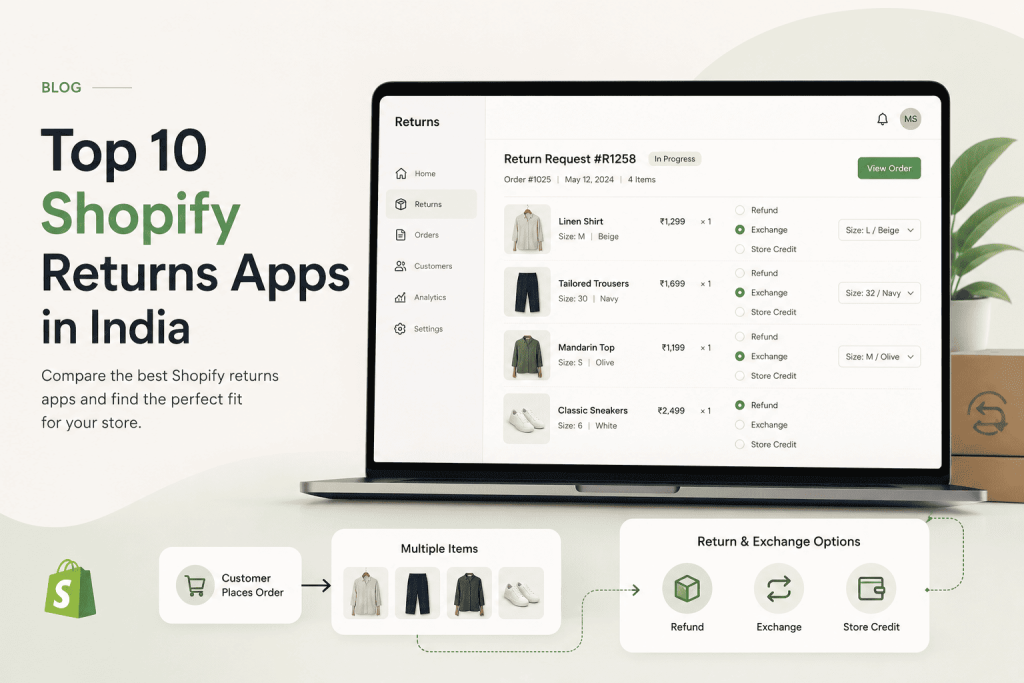
Consider an order containing four products. A customer may want to exchange two products, return one, and keep another.
The returns platform should be able to handle that without forcing the customer to create several separate requests.
3. Indian logistics support
For Indian D2C brands, reverse logistics is an important part of the returns experience.
Look at whether the platform works with the carriers and logistics infrastructure your business already uses.
4. Automation
As return volume increases, manually reviewing every request becomes expensive.
Useful automation can include:
- Eligibility rules
- Automatic approvals
- Return labels
- Notifications
- Exchange processing
- Refund workflows
- Inventory updates
5. Support
Software is only one part of the equation.
When a returns workflow breaks or an integration needs to be configured, having a responsive support team can save considerable operational time.
This becomes particularly important during sales events and periods of high return volume.
6. Pricing
Don’t compare only the advertised monthly subscription.
Look at:
- Included return requests
- Per-return charges
- Label charges
- Premium features
- Automation limits
- Exchange functionality
- Integration costs
A low starting price can become expensive as your store grows.
Best Shopify Returns Apps in India: 10 Tools Compared (2026)
| Solution | Best for | Free plan | Lowest paid plan |
|---|---|---|---|
| QuickReturns | Indian D2C brands, from startup to high volume | Yes (10 requests a month) | $19 |
| Shopify Self-Serve Returns | Basic return workflows | Included with Shopify | Included with Shopify |
| Loop Returns | Established DTC brands | Yes (Checkout+ plan) | $155 |
| Return Prime | Brands already using GoKwik products | Yes (5 requests a month) | $19.99 |
| AfterShip Returns | Scaling merchants | Yes (Return Care plan) | $19 |
| ReturnGO | Workflow-focused brands | No (14-day free trial) | $147 |
| ClickPost | Mid-market & enterprise | Not listed | Custom quote |
| ReturnZap | Growing Shopify stores | No (14-day free trial) | $39 |
| Rich Returns | Stores that want exchange-first returns | No (30-day free trial) | $19 |
| Sorted | Delivery-focused operations | Not listed | Usage-based |
| CWILL Returns & Exchanges (formerly ParcelWILL) | Growing Shopify stores | Yes (6 returns a month) | $29 |
Before looking at individual platforms, it helps to understand what actually matters.
1. QuickReturns
Best suited for: Indian D2C brands on Shopify that want returns, exchanges, COD refunds and courier pickups in one app, starting on a free plan.
QuickReturns is a Shopify returns and exchanges platform designed to automate the post-purchase process. 1,000+ brands use it.
It supports branded return portal, exchanges, store credit, automatic approvals, analytics, and logistics integrations.
One capability that can be particularly useful for fashion and apparel merchants is multiple line-item exchanges.
For example, a customer could purchase several products and want to exchange multiple items from the same order. Rather than creating separate return requests for each product, QuickReturns can handle multiple line items within a single return workflow.
That can make a meaningful difference for brands with larger multi-product orders.
Where QuickReturns stands out
Built for returns in India
A COD order has no card to send the money back to. QuickReturns can refund to UPI, a bank account, store credit or the original payment method.
Reverse pickups are booked with the couriers Indian brands already use, including Shiprocket, Delhivery, Blue Dart and Xpressbees.
Multiple line-item exchanges
This is one of the areas worth paying particular attention to when comparing returns platforms.
A customer may want:
- Shirt → Medium to Large
- Trousers → Black to Beige
- Jacket → Refund
- T-shirt → Keep
Handling these different outcomes within one return request creates a significantly better experience than forcing customers through multiple workflows.
Support
Every plan, including Free, comes with a dedicated account manager, a 1:1 onboarding call and live chat support.
For a returns platform, support isn’t simply about answering product questions. It can involve helping merchants configure policies, troubleshoot integrations, migrate data, and adapt workflows to their specific operation.
Competitive pricing
Cost becomes increasingly important as return volume grows.
The Free plan covers 10 return requests a month. Growth is $19 a month for 60 requests, then $0.40 for each extra request. Every paid plan includes every feature, so you never upgrade just to switch one on.
Migration
Merchants that already use another returns platform can also evaluate QuickReturns as a migration option.
QuickReturns supports migration from other returns apps, including Return Prime.
Modern technology
QuickReturns is built on a modern technology stack designed to provide reliability, scalability, and security as merchants increase order and return volumes.
Who should consider QuickReturns?
It may be particularly relevant for:
- Indian D2C brands
- Brands that already use Shiprocket, KwikShip by GoKwik, Razorpay or Shopflo (see the full integrations list)
- Fashion and apparel stores
- Stores with frequent size exchanges
- Brands with multi-product orders
- Merchants looking for multiple line-item exchanges
- Brands looking for competitive pricing
- Merchants who place a high value on support
- Stores migrating from another returns platform
Our view: For most Indian D2C brands on Shopify, QuickReturns is the app to start with, and the free plan lets you try it on real orders.
2. Loop Returns
Best suited for: Established D2C brands focused heavily on exchanges and revenue retention.
Loop Returns is a returns and exchanges app built for DTC brands on Shopify (see our Loop Returns vs AfterShip vs QuickReturns breakdown).
Its approach puts significant emphasis on exchanges rather than simply processing refunds.
It can be particularly relevant for fashion, apparel, and lifestyle brands where customers frequently return products because of size or preference.
Consider it if: Exchange conversion and an established returns ecosystem are major priorities.
3. Return Prime
Best suited for: Brands that already use GoKwik products and want detailed return rules.
Return Prime is part of GoKwik, an Indian commerce technology company. GoKwik lists Return Prime among its products.
The platform focuses on returns, exchanges, refunds, store credit, return rules, and analytics.
Its free plan covers 5 return requests a month. The Grow plan starts at $19.99 a month for 60 requests, then $0.49 for each extra. By comparison, the QuickReturns free plan covers 10 requests, and Growth is $19 for 60, then $0.40 for each extra. If you are weighing a switch, see our Return Prime alternative page.
Consider it if: Your business needs granular return rules and a broad set of integrations, especially if you already use other GoKwik products.
4. AfterShip Returns
Best suited for: Merchants looking for returns alongside a broader post-purchase technology ecosystem.
AfterShip’s returns product covers return portals, policies, labels, tracking, and analytics.
One advantage for merchants already using AfterShip is the ability to operate returns alongside other post-purchase tools.
Consider it if: You already use AfterShip or want a broader post-purchase technology stack.
5. ReturnGO
Best suited for: Merchants looking for configurable exchange and return workflows.
ReturnGO focuses on automated returns and exchanges, with capabilities around policies, exchange incentives, store credit, and return management.
It can be a useful option for brands that want to configure different outcomes depending on the reason for return.
Consider it if: Workflow customization and exchange incentives are important to you.
6. ClickPost
Best suited for: Larger brands that want returns handled inside a wider logistics platform.
ClickPost approaches returns from a broader logistics perspective.
For larger Indian ecommerce operations, its carrier allocation and multi-carrier integrations can be relevant. QuickReturns also lists a ClickPost integration for reverse logistics.
It may be more appropriate for businesses where reverse logistics complexity is a major concern rather than simply needing a Shopify returns portal.
Consider it if: logistics, carrier orchestration, and enterprise operations are major requirements.
7. ReturnZap
Best suited for: Merchants looking for configurable returns, exchanges, and store-credit workflows.
ReturnZap offers features around return rules, exchanges, labels, store credit, and analytics.
It can be worth considering for merchants that want more control over how different return scenarios are handled.
Consider it if: You want configurable rules without moving to a broader enterprise post-purchase platform.
8. Rich Returns
Best suited for: Shopify merchants looking for a focused returns experience.
Rich Returns & Exchanges gives Shopify stores a self-service returns portal and automated approval rules. It also offers prepaid return labels from more than 50 carriers.
Plans start at $19 a month for 10 returns, then $1 for each extra return. Every plan has a 30-day free trial (Rich Returns pricing).
If you are comparing Rich Returns alternatives in India, first check how many requests each plan includes. Then check whether the app connects to the Indian couriers you use. For example, the QuickReturns Growth plan is also $19 a month and includes 60 requests (see plans and extra-request rates).
Consider it if: Your requirements are relatively straightforward and your return volume is still manageable.
9. Sorted
Best suited for: Brands whose main need is carrier management and delivery tracking.
Sorted sells delivery software: a carrier management product (Ship) and a delivery tracking product (Track).
It can be relevant for merchants whose requirements extend beyond simply giving customers a return form.
Consider it if: Logistics and broader post-purchase operations are important considerations.
10. CWILL Returns & Exchanges (formerly ParcelWILL)
Best suited for: Growing Shopify stores looking for self-service returns and exchange functionality.
CWILL Returns & Exchanges gives Shopify stores a returns portal embedded on the storefront. It has a free plan for 6 returns a month. Paid plans start at $29 a month for 50 returns.
It can be worth comparing for stores looking for a relatively straightforward returns setup.
Consider it if: You want a self-service returns experience and don’t need the complexity of a larger enterprise platform.
How Do These Shopify Returns Apps Differ?
Rather than asking which app is universally “the best,” it is more useful to ask which one fits your operation.
| App | Particularly suited to | Key consideration |
|---|---|---|
| QuickReturns | Indian D2C brands, from startup to high volume | UPI and bank refunds for COD orders, Indian courier pickups, multi-item exchanges |
| Return Prime | Brands already using GoKwik products | Granular return rules, 100+ integrations |
| Loop Returns | Established DTC brands | Exchange-first approach |
| AfterShip Returns | Scaling merchants | Broader post-purchase ecosystem |
| ReturnGO | Workflow-focused brands | Configurable returns and exchanges |
| ClickPost | Mid-market & enterprise | Logistics and carrier orchestration |
| ReturnZap | Growing Shopify stores | Rules and return workflows |
| Rich Returns | Stores that want exchange-first returns | Prepaid labels from 50+ carriers |
| Sorted | Delivery-focused operations | Carrier management and delivery tracking |
| CWILL Returns & Exchanges (formerly ParcelWILL) | Growing Shopify stores | Self-service returns |
Note: We checked prices, free plans and features against each app’s Shopify App Store listing or official site. Prices are in US dollars a month and can change, so confirm them before you decide. The “Best for” columns are our own view.
Sources: Loop Returns, Return Prime, AfterShip Returns, ReturnGO, ClickPost, ReturnZap, Rich Returns, Sorted, CWILL Returns & Exchanges.
Which Shopify Returns App Is Right for Your Business?
There is no reason for a small Shopify store processing a handful of returns each month to choose the same platform as a large D2C brand handling thousands of orders.
If you’re a small Shopify store
Prioritize:
- Simple setup
- Low starting cost
- Basic return portal
- Essential exchange functionality
Shopify’s built-in self-serve returns can cover basic requests. However, Shopify’s setup guide notes that exchanges can’t be requested through them.
If you’re a growing D2C brand
Look more closely at:
- Exchange workflows
- Multiple-item returns
- Automation
- Support
- Pricing at higher volumes
- Logistics integrations
This is where QuickReturns fits most Indian brands: exchanges, multi-item requests, courier pickups and UPI refunds sit in one app. Return Prime, ReturnGO and AfterShip Returns are the other apps to compare.
If you’re an enterprise brand
Look beyond the customer-facing portal.
Evaluate:
- Carrier orchestration
- WMS/OMS integration
- Multiple warehouses
- Analytics
- APIs
- SLA management
- International returns
- Operational controls
Platforms such as ClickPost, Loop, AfterShip, and other enterprise-oriented solutions may be more appropriate depending on the operation.
Final Verdict
Of the Shopify returns apps in India we compared, QuickReturns is our pick for most D2C brands. It has a free plan for 10 requests a month, paid plans from $19 with every feature included, UPI and bank refunds for COD orders, and pickups through Indian couriers. See why brands are switching to QuickReturns.
The other apps fit more specific cases.
Loop Returns is well suited to brands with a strong exchange-first strategy.
Return Prime is worth considering if you already use other GoKwik products and want detailed return rules.
AfterShip Returns makes sense for merchants that want returns alongside a broader post-purchase ecosystem.
ClickPost can be a stronger fit for larger operations where logistics orchestration is central.
ReturnGO, ReturnZap, Rich Returns, Sorted, and CWILL Returns & Exchanges each address different combinations of returns, exchanges, automation, and logistics needs.
There isn’t one platform that will be right for every Shopify store. If you also sell outside India, see our global comparison of the best Shopify returns apps.
For an Indian D2C brand, though, the quickest way to decide is to install QuickReturns on the free plan and run your next 10 return requests through it.
What is a Shopify returns app?
A Shopify returns app helps merchants manage returns, refunds and exchanges from a centralized workflow. Depending on the platform, features can include a branded return portal, automated return rules, exchange management, store credit, reverse-pickup coordination, notifications and analytics.
Which Shopify returns apps are available in India?
Several returns and exchange platforms serve Shopify merchants in India, including QuickReturns, Return Prime, ReturnGO, AfterShip Returns, Loop Returns and other specialized solutions. Features, pricing, integrations and availability vary by platform.
What should I look for in a Shopify returns app?
The most important factors include return and exchange workflows, automation, customer experience, pricing, Shopify integration, logistics support, analytics, store credit, inventory handling and scalability. Indian D2C brands may also want to evaluate COD returns, reverse pickups and integrations with local logistics or OMS platforms.
What should Indian Shopify stores consider before choosing a returns app?
At minimum, evaluate:
- Return policy flexibility
- Exchange workflows
- Multiple line-item exchanges
- Reverse logistics
- Automation
- Support
- Pricing
- Integrations
- Scalability
Which Shopify returns app is suitable for Indian D2C brands?
For most Indian D2C brands on Shopify, we recommend QuickReturns. It has a free plan for 10 return requests a month, UPI and bank refunds for COD orders, and reverse pickups through Indian couriers. The right choice still depends on your return volume, exchange needs, logistics setup and budget.
