How Much Do Returns Really Cost Your Customer Support Team?
Returns Don’t Just Cost Money—They Cost Time
When ecommerce brands calculate the cost of returns, they usually stop at:
-
Refund amounts
-
Inventory write-offs
But there’s a much bigger cost hiding in plain sight,  Customer support.
Every return creates questions. Every question becomes a support ticket. And every ticket adds recurring cost in the form of payroll, tools, training, and management overhead. Over time, this hidden layer quietly becomes one of the biggest operational drains for growing ecommerce brands.
Returns don’t just affect margins. They fundamentally change how your customer support team operates.
This blog breaks down:
-
Where support costs really come from
-
How returns inflate ticket volume
-
The compounding effect on teams
-
And why automation is now a financial decision, not just an ops one
The Overlooked Equation: Returns = Support Load
For most D2C and ecommerce brands, 30–45% of total customer support tickets are related to returns, refunds, or exchanges. Despite this, very few teams track return-related tickets as a separate operational cost.
Returns are often treated as a logistics problem, while customer support is treated as a staffing problem. In reality, returns are a primary driver of support volume.
Returns are not edge cases. They are predictable, repeatable, and scale directly with order volume.
Common Return-Driven Tickets
Return-driven support queries follow the same patterns across most ecommerce brands:
-
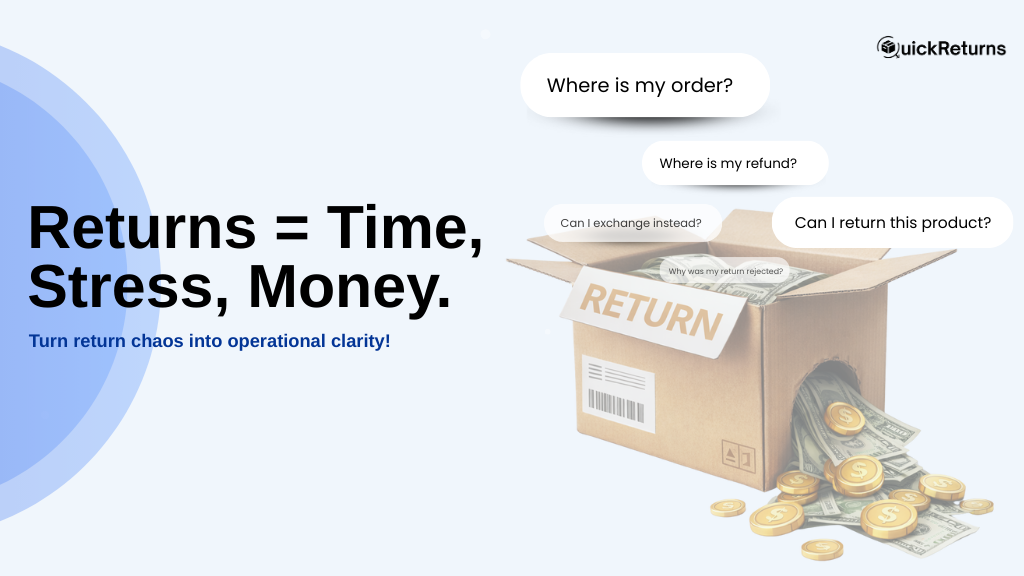
“Can I return this product?”
-
“Where is my refund?”
-
“My pickup failed—what should I do?”
-
“Can I exchange instead?”
-
“Why was my return rejected?”
These are not rare or seasonal questions. They occur daily and increase automatically as order volume grows.
The True Support Cost of Returns
Refund amounts are visible on balance sheets. Support costs are not.
Every return-related conversation consumes agent time, system resources, and managerial attention.
1. Cost Per Ticket (The Silent Multiplier)
On average, one customer support ticket costs ₹50–₹150 ($1–$3) when you include:
- Support agent salaries
- Helpdesk and CRM tools
- Training and onboarding
- Management and quality monitoring
Now multiply that by:
-
Number of return-related tickets
-
Number of follow-ups per ticket
Suddenly, returns aren’t a logistics issue—they’re a support cost explosion. It becomes significant when multiplied by thousands of return-related tickets each month.
2. Why Return Tickets Multiply Instead of Closing (The Follow-Up Effect- Where Costs Double)
Unlike standard support queries, return and refund tickets rarely close in a single response.
A typical refund conversation involves:
-
Customer asks about refund
-
Agent checks order
-
Refund not processed yet
-
Customer follows up after 2 days
-
Agent replies again
-
Customer follows up again
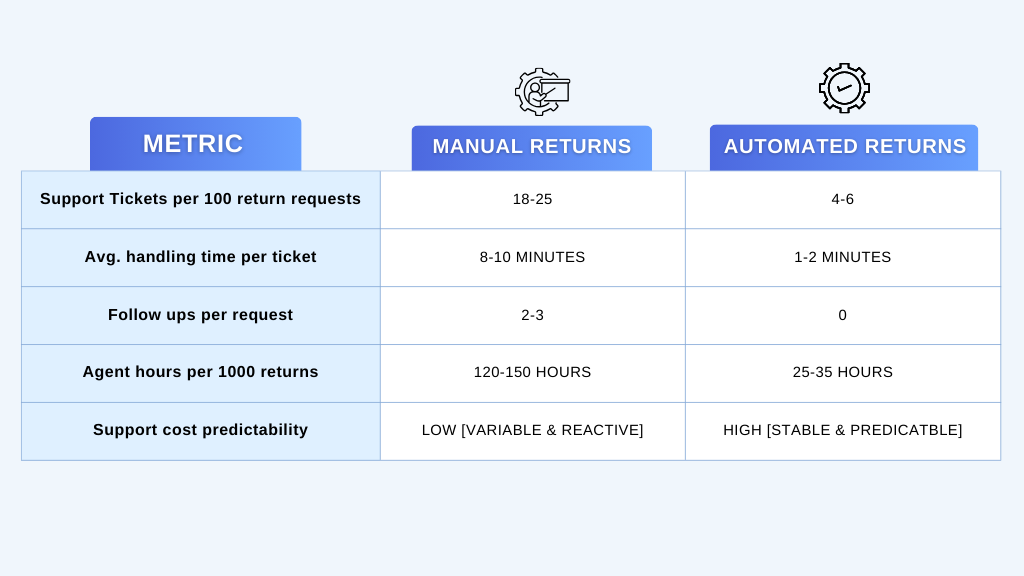
In practice, one return often generates three to five support interactions. Each follow-up adds incremental cost, increases queue length, and reduces overall team efficiency. This is how returns quietly inflate customer support workload.
3. WISMO → WISMO-R: Where Is My Refund?
Most ecommerce teams are familiar with WISMO (“Where Is My Order?”). However, WISMO-R (“Where Is My Refund?”) tickets are significantly more expensive and difficult to handle. Refund-related tickets involve:
- Money
-
Disappointment
-
Fragile Trust
Customers are already unhappy, and uncertainty around refund timelines increases emotional intensity.
As a result, WISMO-R tickets:
-
Take longer to resolve
-
Escalate more frequently
-
Create higher emotional fatigue for agents
These tickets cost more than average tickets.
4.How Returns Force Customer Support Teams to Scale
As order volume increases, return volume grows proportionally — often faster. This growth appears immediately in customer support queues.
Many ecommerce brands hire additional support agents not because sales increased, but because return-related tickets became unmanageable.
This creates a recurring pattern:
Growth → More returns → More support tickets → More hiring → Higher operational burn
At scale, returns become a structural support cost problem, not just an operational inconvenience.
Example: The Math Most Ecommerce Brands Never Calculate
Let’s take a simple example:
-
10,000 orders per month
-
20% return rate = 2,000 returns
-
1.5 support tickets per return = 3,000 tickets
-
₹100 per ticket cost
That results in ₹3,00,000/month spent purely on return-related customer support
That’s:
-
One full-time team
-
Or a senior ops hire
-
Or a meaningful product investment
And this cost repeats every month and increases as the business scales.
Why Returns Create Disproportionate Support Pressure
Returns are different from normal tickets. Return-related tickets combine multiple layers:
-
Policy questions
-
Logistics coordination
-
Financial anxiety
-
Emotional dissatisfaction
Each layer increases handling time and complexity. This is why:
-
Return tickets take longer
-
Agents feel drained
-
CSAT drops during refund periods
The Hidden Costs Beyond Payroll
1. Slower Response Times
As ticket volume increases:
-
SLAs slip
-
Customers send follow-ups
-
Volume increases further
A feedback loop no one wants.
2. Agent Burnout & Attrition
Return conversations are repetitive and stressful.
High attrition leads to:
-
More hiring
-
More training
-
More inconsistency
Which again increases ticket handling time.
3. Customer Trust Erosion
Delayed or unclear returns lead to:
-
Negative reviews
-
Low repeat purchases
-
Higher lifetime support cost per customer
Why “Hiring More Support Agents” Is the Wrong Fix
When support volume increases, many brands respond to rising tickets by:
-
Hiring more agents
-
Outsourcing support
-
Extending response SLAs
While this may provide short-term relief, it does not address the root cause.
Returns are process-heavy, not people-heavy. Adding more agents to an inefficient return process only increases cost without reducing ticket volume.
The Structural Fix: Reduce Support Tickets at the Source
High-performing ecommerce teams shift their mindset from reaction to prevention.
Instead of asking how to respond faster, they ask why the question exists in the first place.
This leads to:
-
Self-serve return initiation
-
Clear return eligibility rules
-
Real-time refund and pickup status visibility
-
Automated updates and decisions
In short, return automation.
How Return Automation ReducesCustomer Support Costs
Automation doesn’t replace support teams. It removes unnecessary conversations.
When customers can initiate returns, see eligibility instantly, and track refund status in real time, they no longer need to contact support. Automation reduces:
1. Fewer Tickets Created
When customers can:
-
Initiate returns themselves
-
See eligibility instantly
-
Track refund status
They don’t open tickets.
2. Zero Follow-Ups
Automated status updates remove:
-
“Any update?”
-
“Please check”
-
“Still waiting”
Each update prevents a new ticket.
3. Faster Resolution = Lower Cost
Shorter ticket life = lower cost per ticket.
Automation compresses timelines:
-
Faster refunds
-
Faster exchanges
-
Fewer escalations
Shorter ticket lifecycles directly reduce support cost per order.